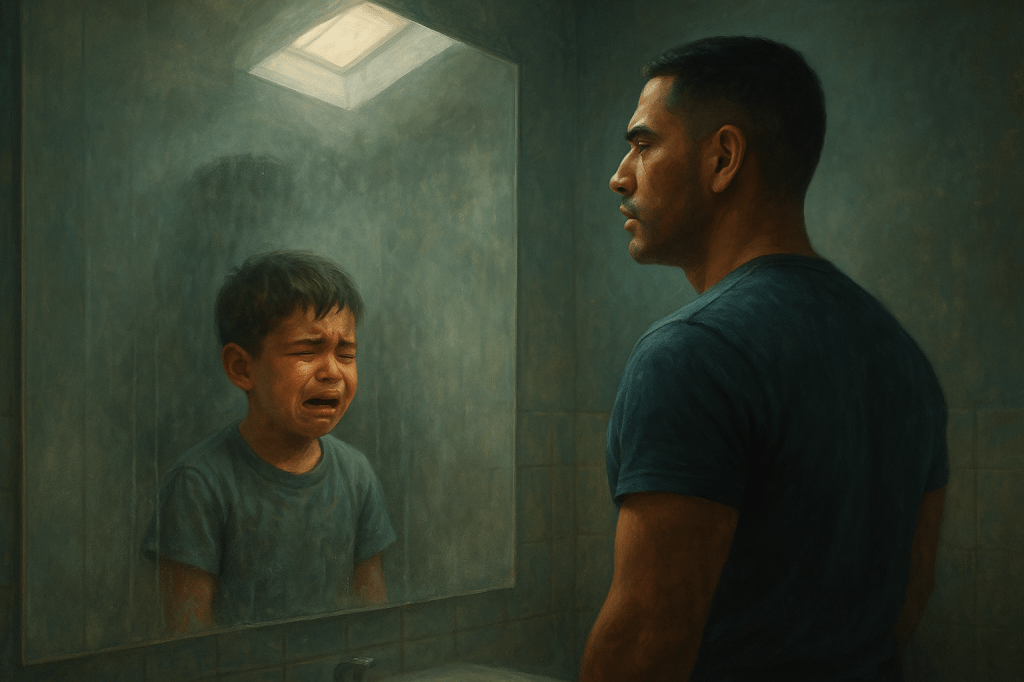
It’s not casual. It’s not polite. It’s emotional. I love it like a fool who knows better. My favorite is iced coffee with oat milk, a little honey, and just a tiny bit of creamer. That’s it. Cold, sweet, and smooth. Every sip makes me happy, even while my body plots against me.
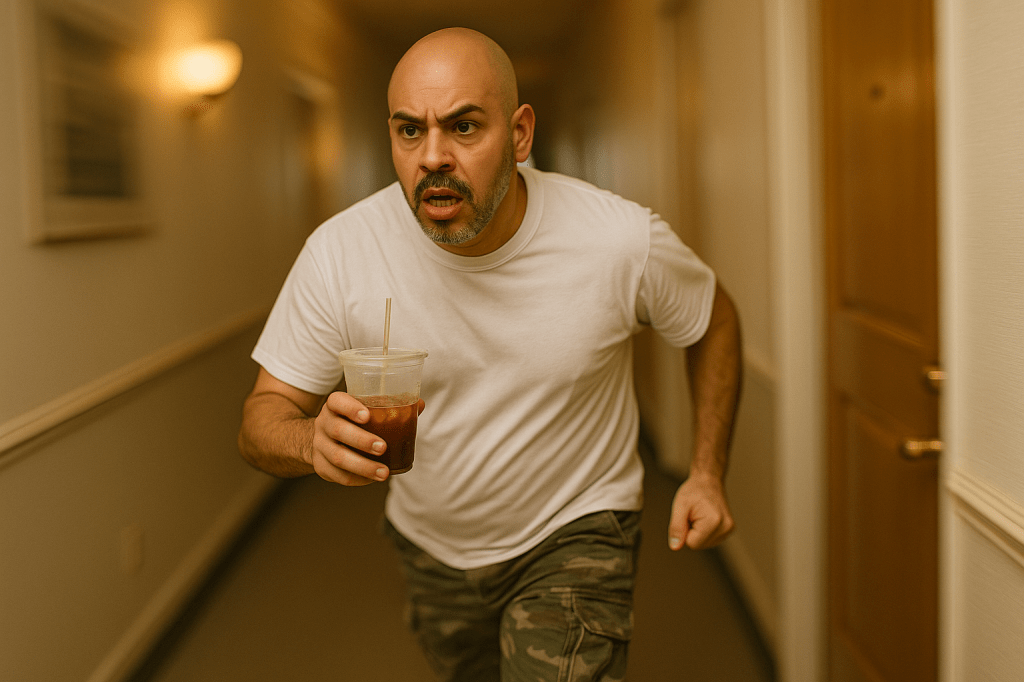
Living with multiple sclerosis means almost every choice comes with conditions. Coffee is one of them. It helps me focus, gives me energy, and makes mornings less miserable. But the trade-off? It sends my bladder into panic mode. Some days, it feels like I’m going to piss on myself. And sometimes, I do. That’s the truth no one puts on inspirational posters.
Still, I drink it.
Every morning. Without fail.
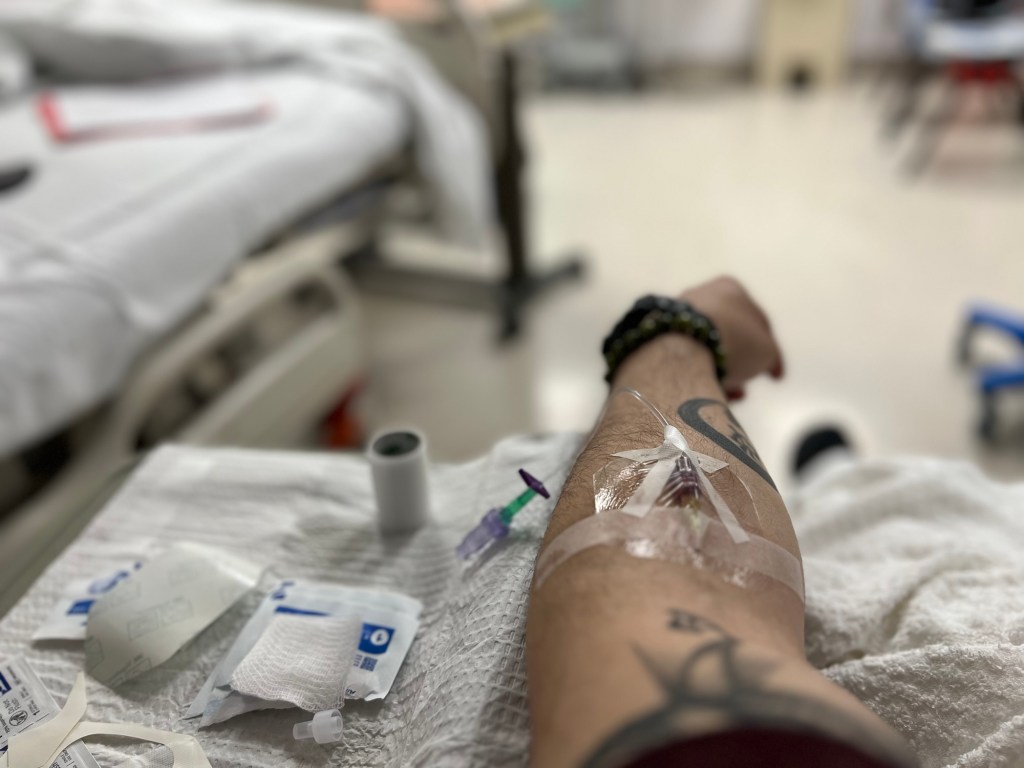
Oh GOD please NO! I’m almost there.
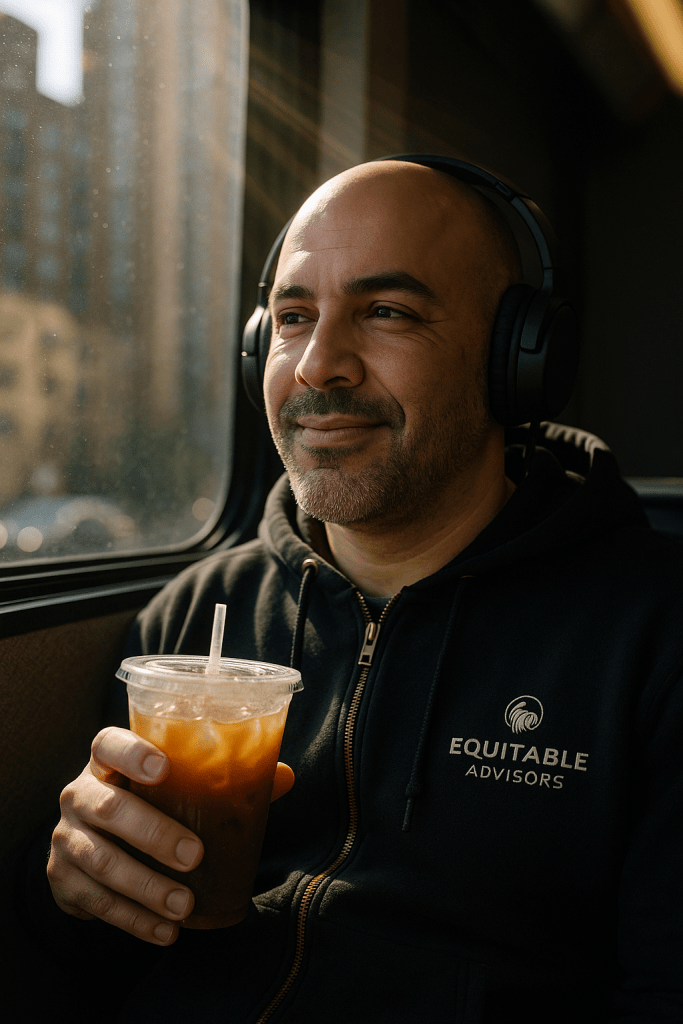
It’s part of my routine, my mental ignition switch. Once I take that first sip, the fog that MS brings starts to lift. I put on my headphones, hit play on my endless playlist of over 250 hours of music, and I can finally think. My brain starts connecting again. I feel sharper, more capable, more me.
That’s the magic part of caffeine. Studies show it can boost alertness, concentration, and short-term memory. It gives your central nervous system a small jolt, helping you stay awake and focused. For many people with MS, that little spark can make a big difference when fatigue feels like a full-time job.
But there’s the other side. The one nobody romanticizes.
Caffeine is a diuretic. It makes you pee more. For people with MS, that can be a problem, especially if you already deal with bladder urgency or incontinence. It can also upset your stomach or make anxiety worse if you have a lot of it. And if you drink it too late in the day, it can wreck your sleep.
It’s a beautiful morning!!
So why do I still do it? Because it helps me start the day. Because it’s one of the few pleasures that still feels like mine. Because the smell of coffee in the morning makes me feel human before the rest of the world starts demanding things.
I know what the experts say. Keep it under 400 milligrams a day. Avoid it if it triggers symptoms. Listen to your body. And I do. But my relationship with caffeine isn’t about perfection. It’s about balance. Some days I win. Some days I lose. But most days, I get through the morning feeling awake and present, and that’s worth it.
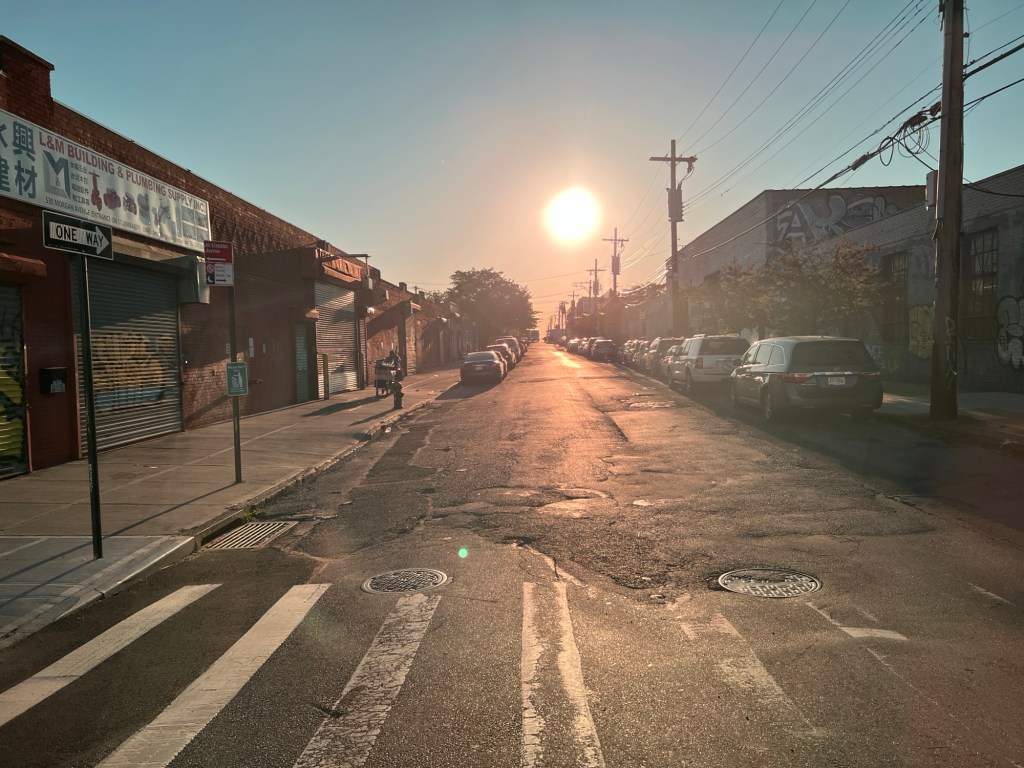
Oh look a Dunkin Donuts on the corner!
Yes, my bladder might betray me. And yes, I can practically hear myself getting fat from the oat milk and honey. But that first sip is peace. It’s clarity. It’s control in a body that doesn’t always cooperate.
So no, caffeine and MS don’t make the healthiest couple. But like every messy relationship worth having, we make it work.
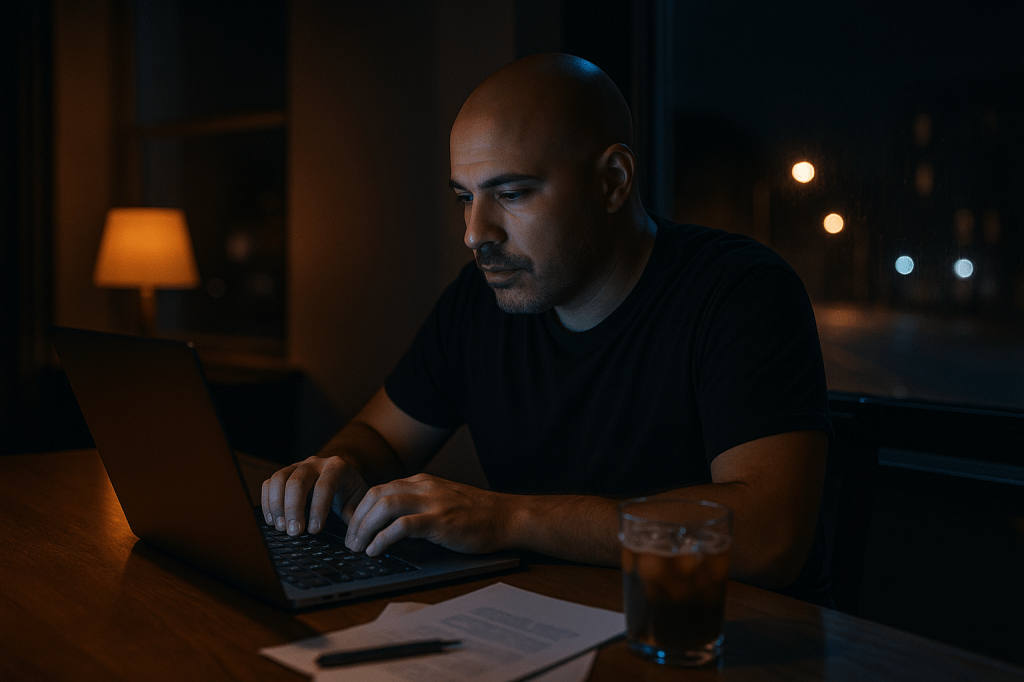
Me not being able to sleep at night.
Author’s Note:
Living with MS means choosing your battles. Some days, it’s walking. Some days, it’s bladder control. And some days, it’s deciding whether coffee is worth the risk. For me, it usually is. Because life with MS isn’t about perfection. It’s about finding small joys in the middle of the mess. This story is one of mine.
Living with multiple sclerosis teaches you to recognize certain buzzwords. You start to hear them so often they become background noise: “New treatment option!” “Promising trial results!” “Exciting breakthrough just around the corner!”
If you’re in the relapse-remitting stage, those words sound like a lifeline. A new infusion, a fresh pill, something to shove the beast back into its cage, at least for a while.
But the moment that diagnosis shifts to secondary progressive MS, the soundtrack changes. The anthem of resilience fades out, and what’s left feels like elevator music on endless repeat. That’s when the words you never forget come crashing in:
“There’s less we can do now.”
Translation? Good luck out there
Welcome to Treatment Limbo
With SPMS, the treatment menu shrinks. Some drugs you once relied on get crossed off. Others aren’t even recommended anymore. Clinical trials? Suddenly, you don’t fit the criteria.
And it makes you wonder: who does fit the criteria? Olympic athletes with a touch of MS that clears up after a nap? Because it sure doesn’t seem like they’re looking for people like me.
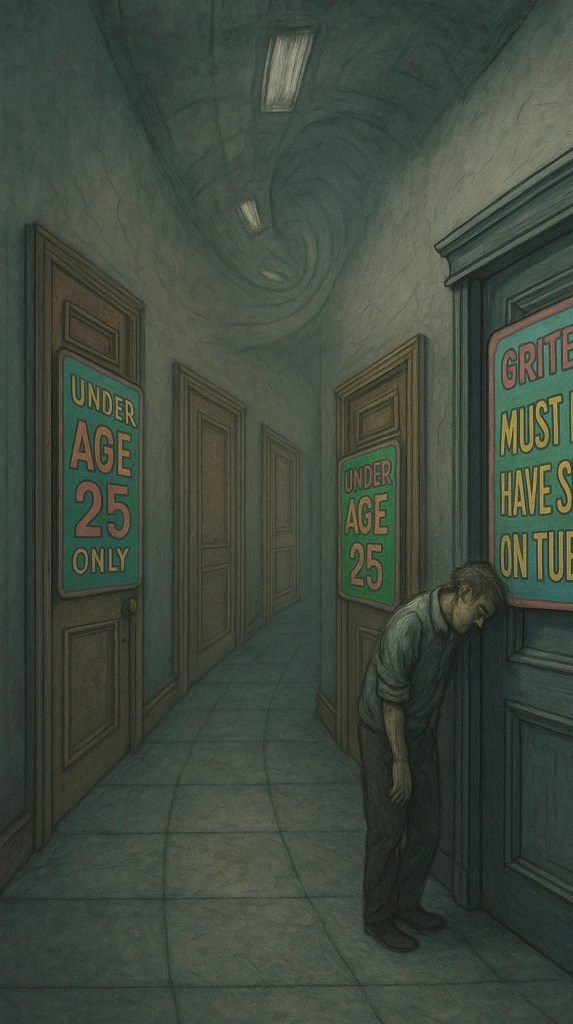
Meanwhile, the news cycle parades shiny headlines: “Scientists discover potential MS breakthrough!” You want to cheer. You want to believe. And then comes the fine print: “Results apply only to early relapse-remitting patients under age 25 who have never sneezed on a Tuesday.”
So, once again, it’s another party I’m not invited to.
The Weight of Waiting
Hope doesn’t die with SPMS, but it turns into a scarce resource. You learn not to get too excited about bold announcements, because nine times out of ten, SPMS patients aren’t even mentioned.
It’s like standing outside a candy shop, watching everyone else sample treats, while the shopkeeper tells you: “Maybe next decade for you.” Eventually, you stop pressing your face to the glass, not because you’ve stopped craving it, but because the cold feels humiliating.
But still, you don’t stop hoping. You just fold it up and keep it in your pocket, careful not to let it break.
Everyday Decisions in Limbo
Treatment limbo isn’t just about medication. It creeps into everyday choices:
• Should I spend money and energy on home modifications now, or keep waiting for the miracle cure the headlines keep promising?
• Do I risk enrolling in a dangerous trial, or protect what little stability I have left? “Possible side effects” sounds scarier when your baseline already feels like a car crash.
• Is it even worth planning five years into the future, or am I just daring fate to laugh in my face?
Living in limbo means constant mental gymnastics. And honestly, I couldn’t land a cartwheel even in middle school.
What Rarely Gets Said
Yes, science is advancing. But here’s the part you rarely see in print: behind every glossy “breakthrough” headline are people like me, waiting and wondering if this one will finally count, or if we’ll be left out again.
That’s the silence of SPMS. Not hopelessness. Not despair. Just hope left hanging in the air, suspended and untethered.
My Closing Thoughts
The hardest part of SPMS isn’t the absence of a cure. It’s the gap between what gets reported and what we actually live.
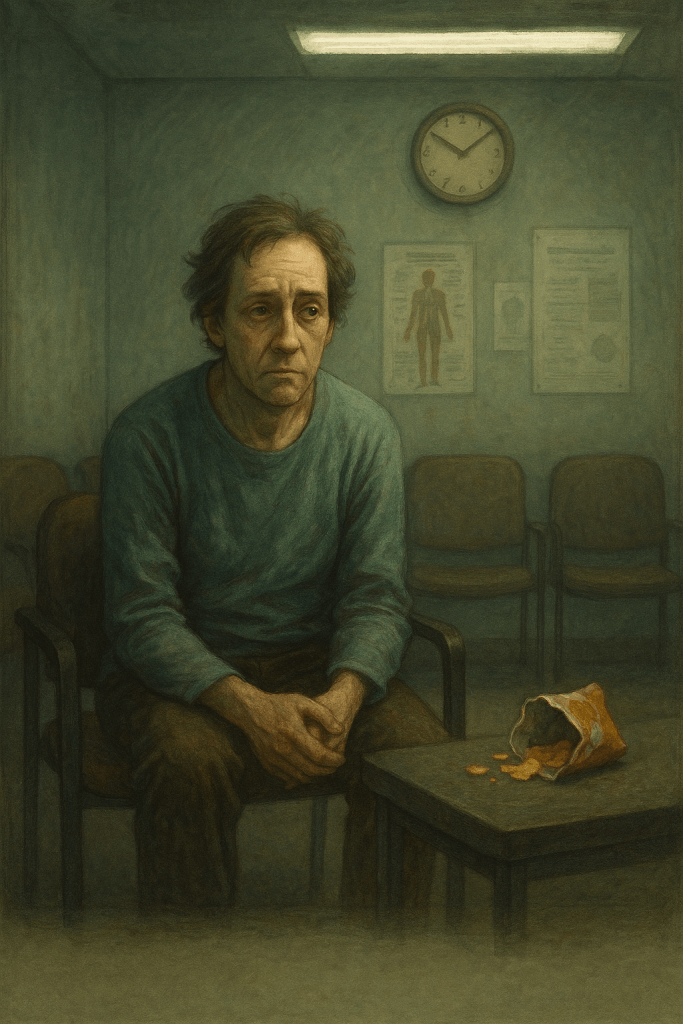
So if you’re here in this waiting room with me, welcome. There are snacks (mostly sarcasm). If you’re not, remember this: every headline about “hope for MS” doesn’t mean hope for everyone with MS.
Until then, I’ll keep rationing my hope, cracking my bad jokes, and shaking my fist at the medical fine print. Because really, if you can’t laugh at the absurdity of being excluded from the cure for the disease you actually have, then what else is left?
The path is always lit up for you. You just have to open your eyes.
Had a conversation with a friend today. Funny thing is, I was in the middle of writing a completely different blog post than the one I have for you today. But once we talked, I couldn’t shake the weight of our exchange. It felt like one of those moments you don’t want to lose to memory alone.
The truth is, I never really pictured myself writing for others to read. Putting words on paper is one thing, but letting the world peek through the window? That feels like standing exposed, naked in my truths and afraid of what people will think when they see me this way.
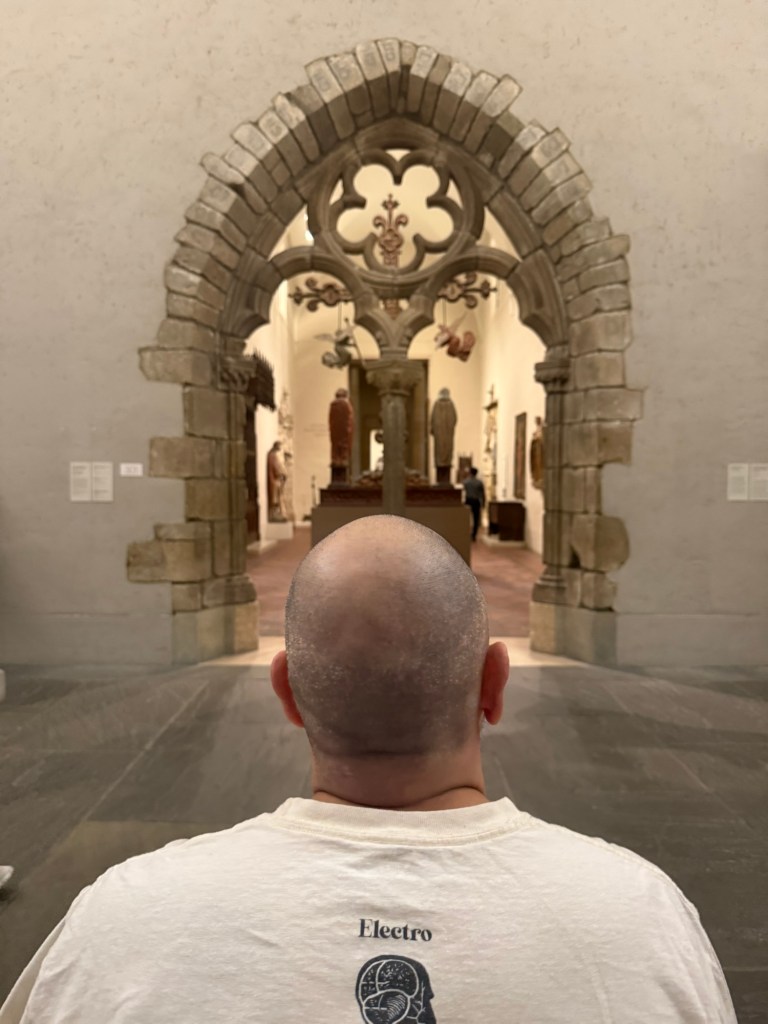
New phone who dis?
But here’s the part that keeps me writing anyway: I believe God places people in our path for reasons we don’t always understand. Sometimes they’re not here to teach you a lesson in the obvious sense, they’re here to remind you of who you are, and that He’s walking alongside you. I’m not the most traditional believer. Organized religion never fully spoke to me. Still, I can’t deny that certain connections run deeper than surface, brushing up against the soul in ways words barely capture.
My journey began long before multiple sclerosis came storming into my life and flipped everything upside down. Struggle, trauma, loss, self-destruction, I’ve sat with all of it. But when I sit with my friend, we don’t dwell on pain. We end up talking about gratitude, about how God moves through us and blesses us even when life feels heavy.
We are all one.
And maybe that’s the point. Maybe these people who enter our lives aren’t random at all. They’re living reminders that we’re never really walking alone.
What stayed with me after that conversation wasn’t just the words, it was the reminder that people themselves can be messages from God. We look for signs in the sky, answers in books, or some booming voice to show us the way. But more often than not, it’s the person sitting across from you, laughing with you, or even challenging you, who carries the reminder that He hasn’t gone anywhere.
My friend didn’t try to fix me or give me some profound sermon. Instead, the simplicity of their gratitude, the way they saw God moving in the everyday, reminded me that blessings don’t always wear grand clothes. Sometimes they show up in the form of a listening ear, a shared story, or a quiet moment that re-centers you.
I am Absolute.
When I think about the hardships I’ve carried struggle, illness, loss, it would be easy to let them define me. But gratitude changes the lens. It doesn’t erase the pain, but it shifts the focus. It says: yes, this happened, but look at what else happened too. Look at who walked in when you thought you were alone. Look at the way love still found you.
That’s what these connections do. They peel back the noise of life and point you straight to the truth: God is present, not just in church or holy texts, but in the people who remind you of your worth, who hold up a mirror so you can see yourself more clearly. And every time I encounter that, I feel less afraid to share my story because my story isn’t just mine. It’s a collection of all the people God has placed along the way.
A special sincere thank you to those who read my blogs, and are moved by my words. I do this not only for you but for me to leave something behind to remember me by. I love you and I hope you love me too.
This post is messy. It’s scattered. I wrote most of it in the back of an Access-A-Ride van , and then sometimes late on a Friday night. These notes are just random thoughts I sit down with when I am alone. These are raw notes from my “F-U Personal Journal.” I cry when I write like this. Not once or twice. Every time. Because when I tell the truth to myself, it hits hard.
My body misfires.
Muscles feel weird, they tingle and twitch without warning.
Feet drag.
Hands get stiff and cramped.
Sometimes I pee before I’m ready.
Sometimes I can’t pee at all.
Sometimes I pee on myself.
This is MS.
It attacks the protective layer around your nerves.
Messages get scrambled.
The connection breaks down.
When your body starts lying to you, trust becomes a problem.
You could breathe through anything except for death.
You second-guess the recliner.
You second-guess the walk to the bathroom.
You second-guess your own timing.
You second guess walking down the stairs.
The trust issues aren’t mental.
They’re neurological.
They show up in your gait, your joints, your breath.
They change how you move.
They change how you plan.
You stop trusting mornings.
You stop trusting heat.
You stop trusting your body to act right in public.
You have to try and trust the process
You start looking for patterns that don’t exist.
You overthink.
You brace for the next fall.
You assume collapse is close.
Then the spiritual trust starts to fade.
You question your path.
You question God.
You question purpose.
You stop praying.
You stop meditating.
You stop expecting.
This happens fast.
One bad week.
One small fall.
One public accident.
Then your beliefs start slipping too.
All I could do is be aware of what’s happening
I show up by writing.
I show up by resting.
I show up by talking to my wife without pretending.
I show up by asking for help when I need it.
None of this feels natural.
But it’s necessary. My up bringing taught me to be self reliant. It is hard for me to ask for help.
I don’t trust every step.
I don’t trust everyone.
I trust breath.
I trust timing.
I trust Spirit, quietly.
Again sometimes you gotta follow the breathe to come home
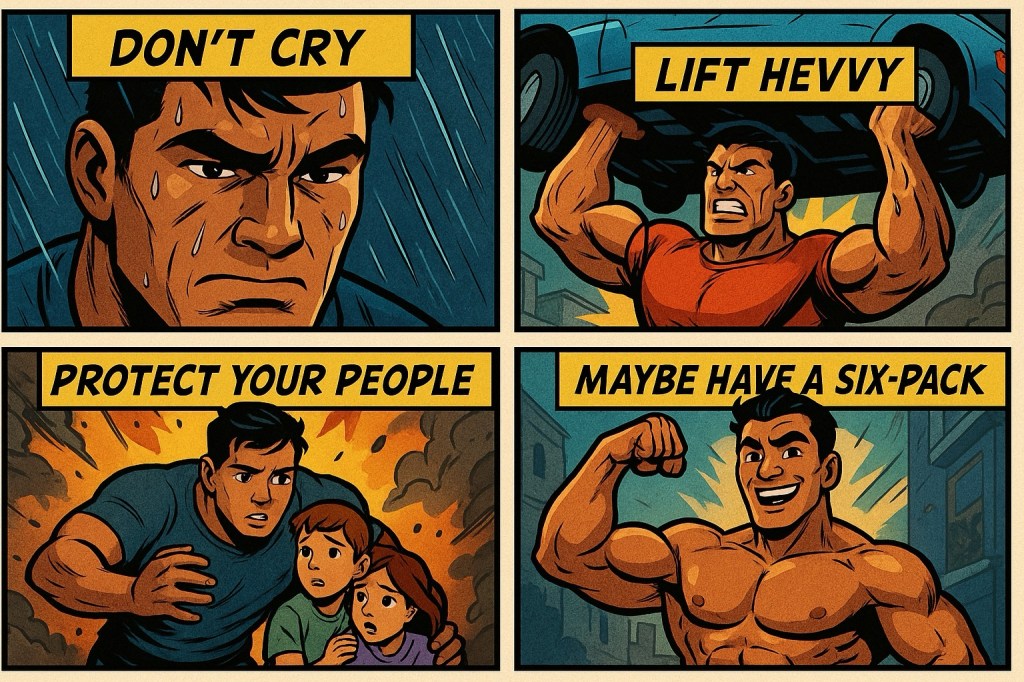
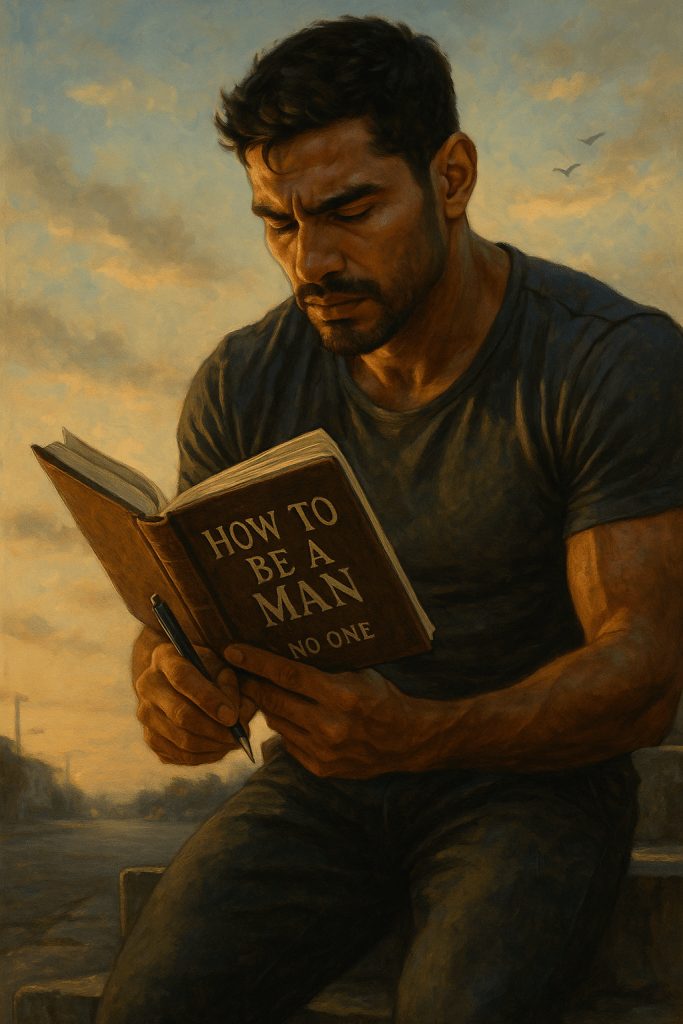
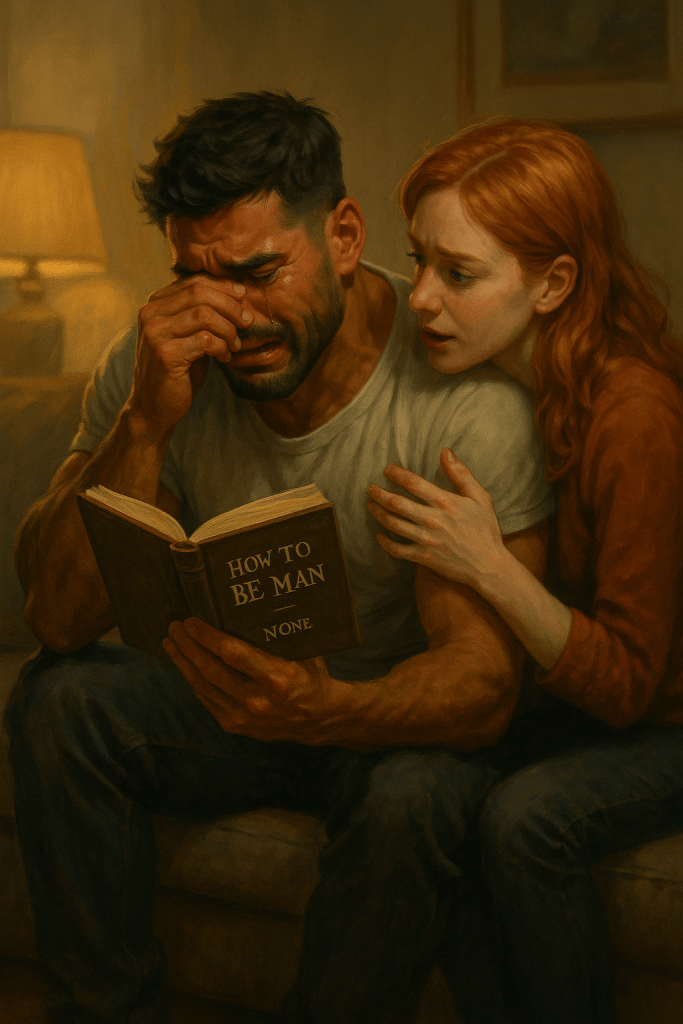
If you’d asked 16-year-old me what being a man looked like—well, growing up in the Lower East Side during the ‘80s, I probably would’ve tossed out something ridiculous like:
“Don’t cry. Lift heavy. Protect your people. And hey, maybe throw in a six-pack while you’re at it.”
That was pretty much the unofficial “man-up” starter pack.
And for a long time, I stuck to it. I hauled all the groceries upstairs in one go—arms burning, pride intact. Didn’t ask for help. Didn’t admit when something hurt. I just push-through. Or poured a drink and shoved the pain somewhere quiet. Independence was everything. My body was proof I had it all together.
Then MS barged in, uninvited.
No warning. No knock. Just kicked the damn door off the hinges and said, “We’re flipping the script” get on the floor!!!! Give me all your energy!
Suddenly, my legs had their own agenda. My Energy? Came and went like a moody roommate. I went from being the one who moved the furniture to the one sitting in it, needing help just to get up. And let me tell you—there’s no section in any manhood guidebook that covers asking your wife, grown as you are, to help you out of bed just so you can pee.
At first, I panicked. Thought maybe I was losing who I was.
Because we’re taught that strength is about action. Pushing. Lifting. Enduring. Never letting anyone see the cracks. But MS? It forced me to sit with something uncomfortable:
Real strength sometimes means stopping.
Not because you gave up—but because you finally decided to stop pretending.
It’s letting your wife see you “Ugly Cry” without laughing them off.
It’s telling your kids, “I can’t today,” and trusting they’ll love you anyway.
It’s asking for help without feeling like you just checked your man card at the door.
And here’s the crazy thing: I didn’t lose manhood. I just had to redefine it. Not really by choice, a decision to mentally survive the long game ahead.
Turns out, I’m still strong—just in ways that don’t always show up in muscle. I protect my family with more than my back. I protect them with presence. With showing up, even when my legs don’t. With listening when I’ve got nothing else to give. With humor. With stubborn love.
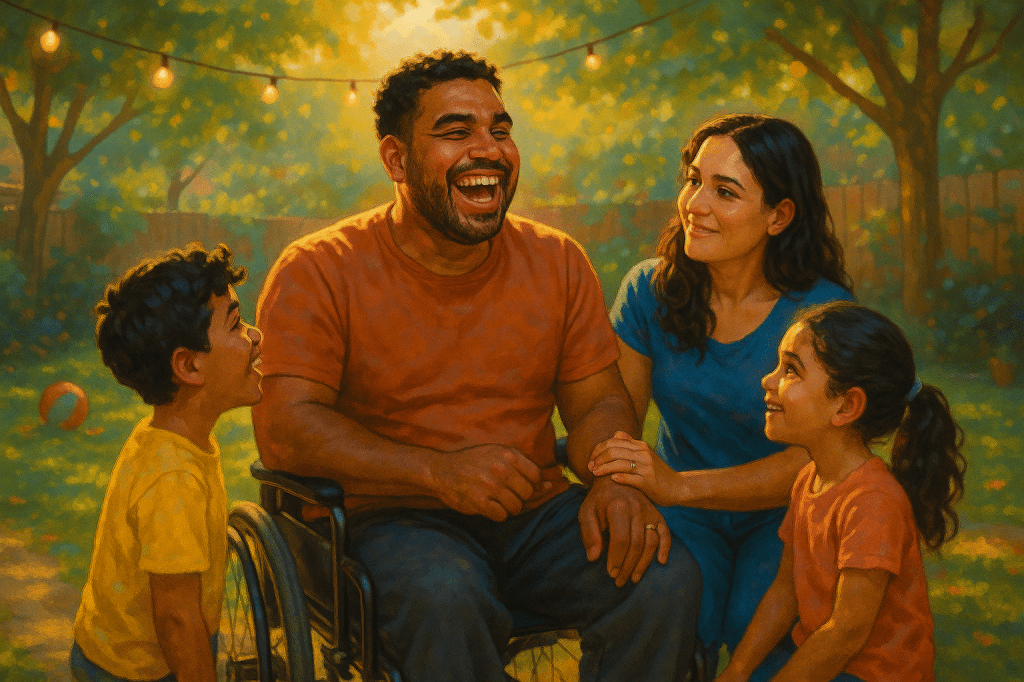
Fatherhood feels different now. My kids don’t just remember the guy who walked them to school or made sure they had the freshest gear. They see the guy who rolls in a wheelchair and still manages to show up—who laughs, who stays soft, who still loves their mom like it’s day one. They’ve learned that being tough doesn’t mean being hard. It means staying kind when life’s been anything but.
That last sentence hit me hard as I wrote it, not gonna lie. I got a little misty eye.
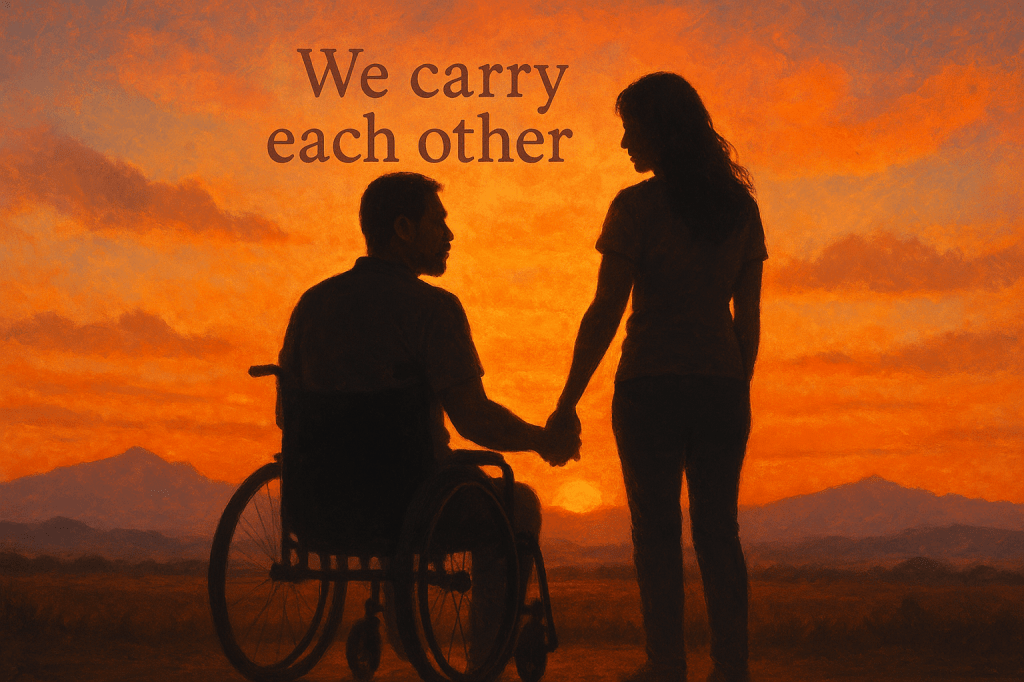
Partnership, too—it’s on a whole new level. My wife? She didn’t stick around because I can carry heavy things. She’s here because we carry each other. We’ve had the kinds of conversations that peel your ego back like old paint—where you admit you’re scared, worn out, or just need to be held. That’s not weakness. That’s trust. That’s real intimacy. That’s grown-man strength.
So yeah, I’m off the “man-up” train for good.
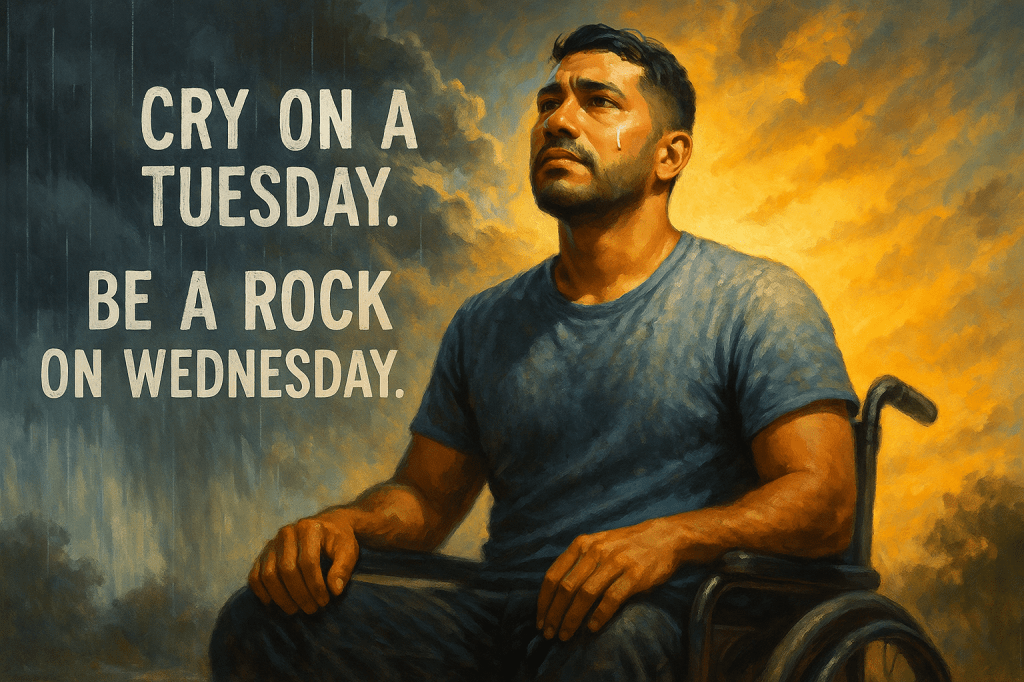
If manhood means bottling it all up, pretending nothing phases you, and dying with your pain locked in your chest—I’m not interested. I’ll take the version where you speak honestly about what hurts. Where you cry if you need to. Where you’re still the rock, just not made of stone.
MS stripped away parts of my independence, sure. But it gave me something better:
A masculinity built on honesty. Connection. Grace. And yeah, vulnerability too.
Funny thing? That kind of strength—the kind rooted deep in who you are—it doesn’t go anywhere. Not even when your legs do.
Because strength isn’t just what you carry.
It’s what you’re willing to share.
I have not said this in a while but, “I love you and I hope you love me too”.
The other night I had a dream. And like most dreams, it didn’t ask for permission—it just arrived, vivid and weird and strangely sacred…. I think.
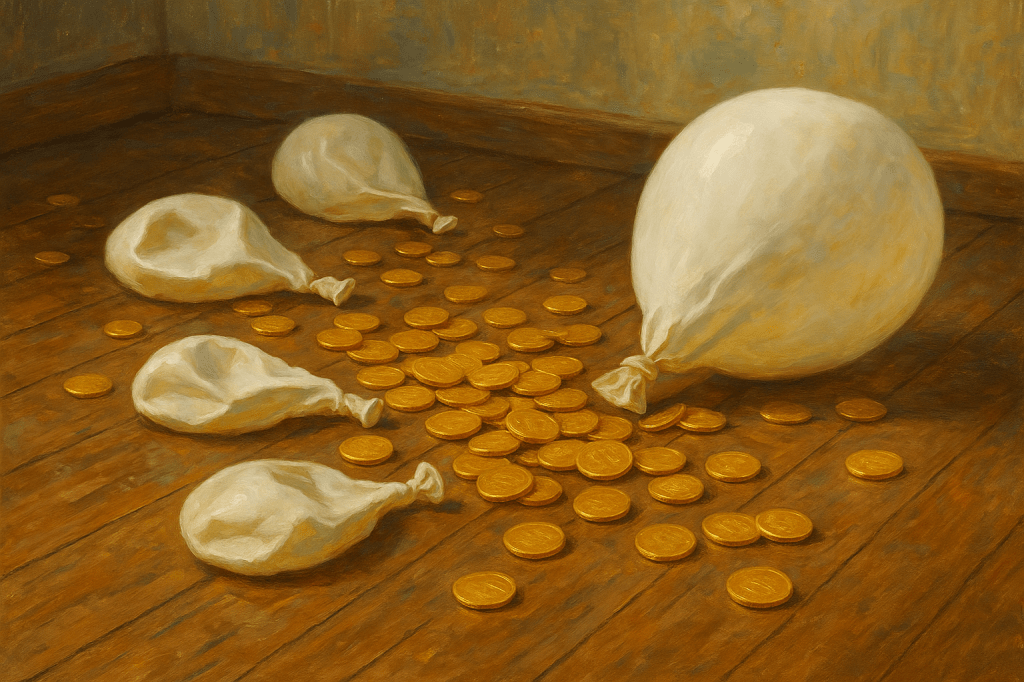
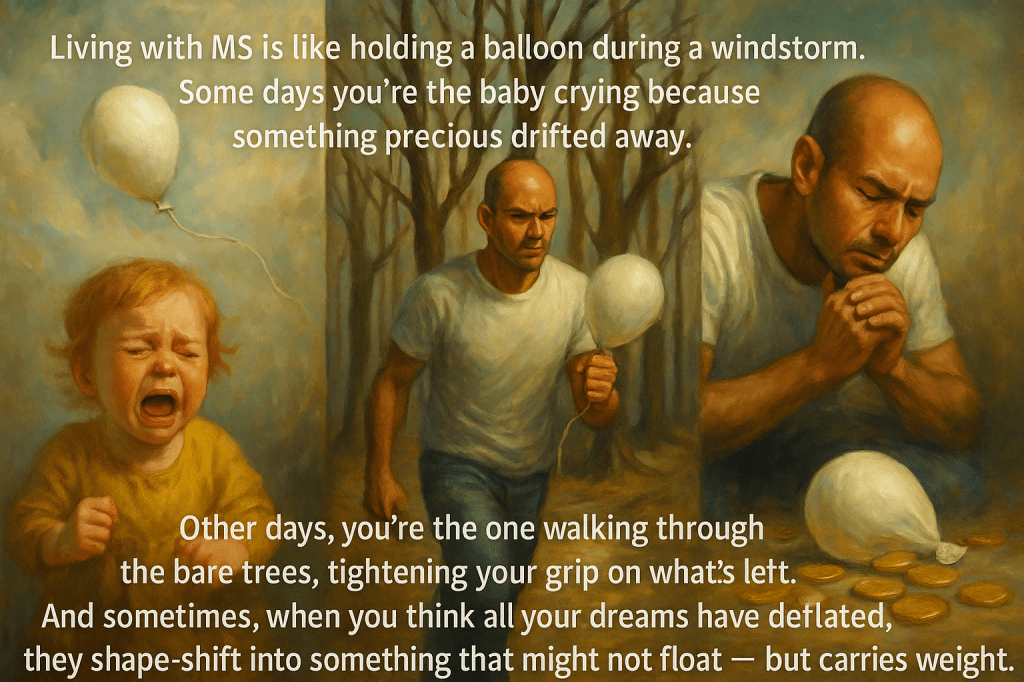
I was walking through a quiet neighborhood. Fall had clearly checked in: the trees were bare, the air felt crisp, and I was with my best friend’s parents and a small child—maybe two or three years old. We found two balloons along the way. Simple white ones. Joyful, floating, light. The kind that make toddlers smile and grown-ups nostalgic.
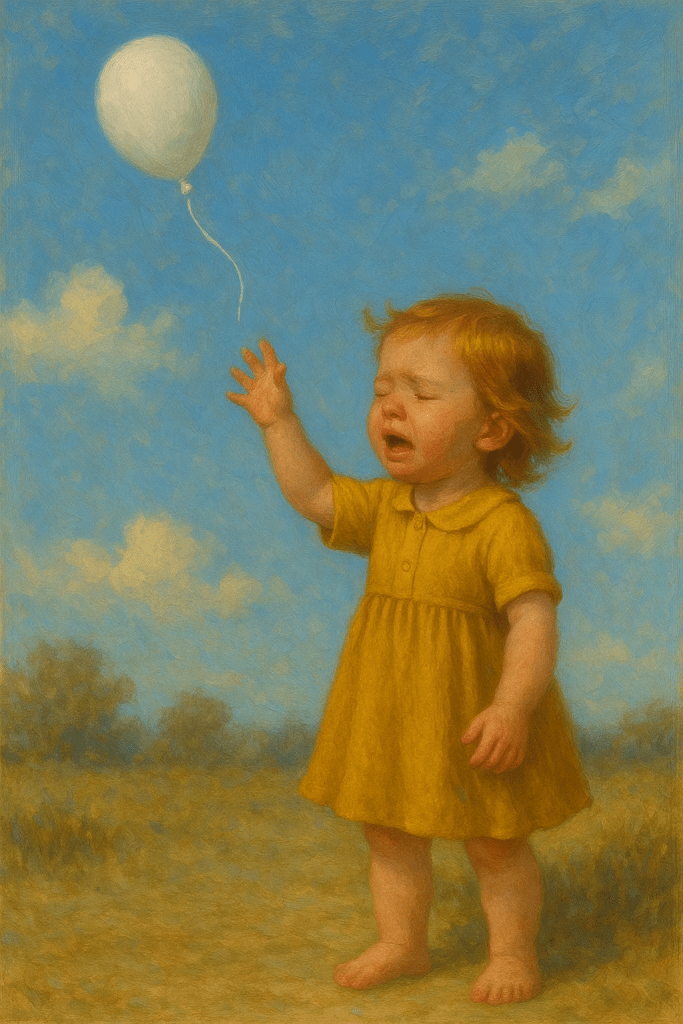
The baby cried. I don’t know if it was her balloon or just the idea of something pure drifting off forever. But we comforted her and went to get another one. Because that’s what you do when something good escapes your hands—you try to bring back a version of it.
We kept walking. Me, the baby, the balloons, and the falling season.
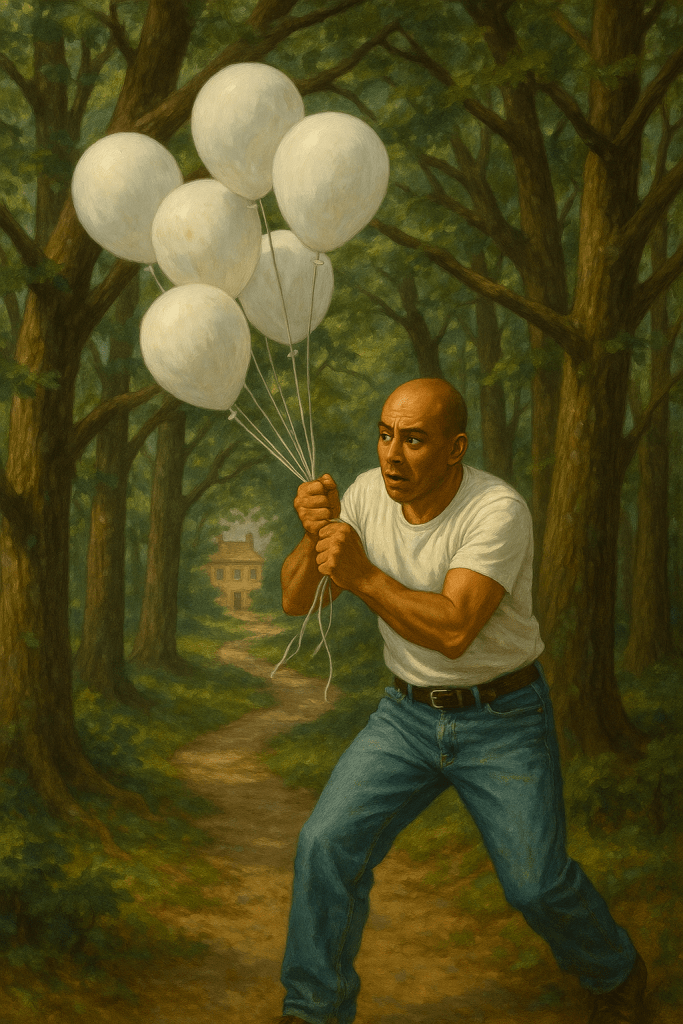
Somehow, as dreams go, I began collecting more white balloons—walking through a neighborhood that looked both familiar and not. But the trees, tall and bare, made me nervous. I worried the branches might pop what I was holding. So I did what any balloon-carrying, overprotective spirit-warrior would do: I brought them in closer. I held them tightly, protecting these fragile floating things like they were sacred.
Eventually, I arrived at an apartment—maybe mine, maybe someone else’s—but I knew I was safe there. And here’s where it gets trippy.
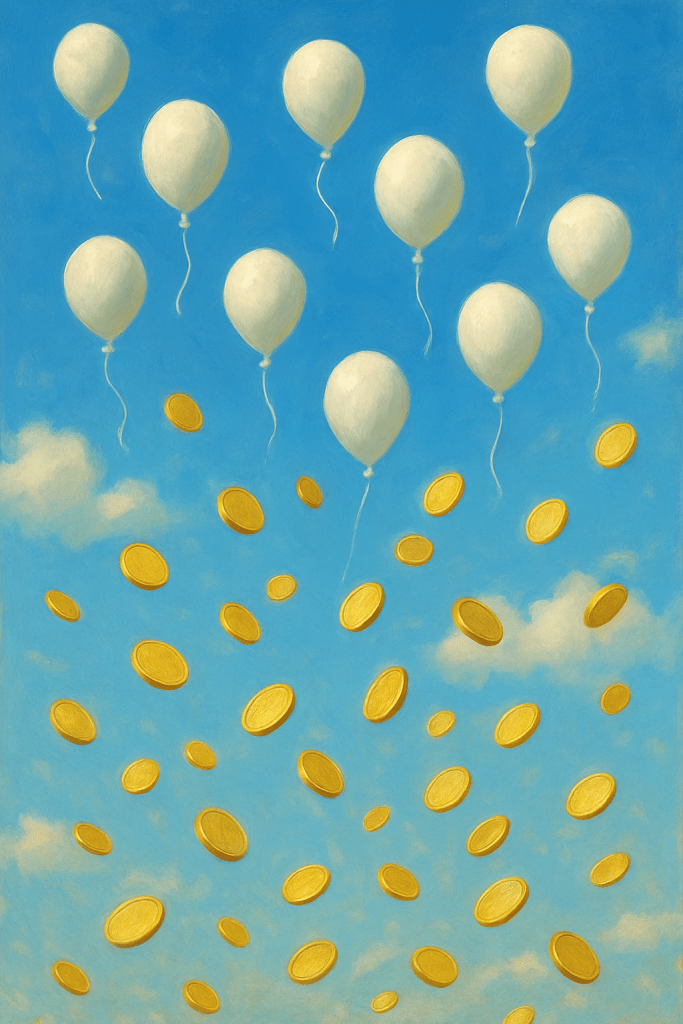
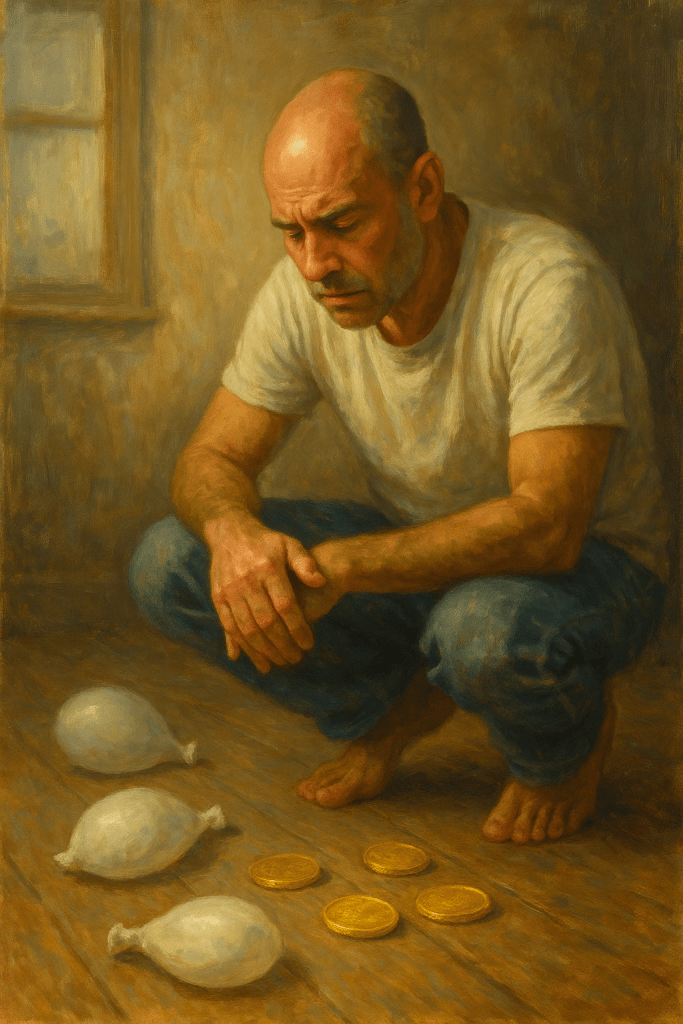
I released the balloons into the room, expecting them to rise. But they didn’t. They deflated mid-air, falling gently to the ground… and when they hit the floor, they transformed into coins.
Yeah. Coins.
Not quarters or nickels or anything I could identify. Just strange, sacred coins. I dropped to my knees and stared at them like a man trying to decipher a challenging Sudoku puzzle. I turned to the baby and whispered something that surprised even me:
“Don’t worry… they’ll turn back into white balloons.”
I woke up still holding that sentence in my chest.
I don’t always recognize the coins this illness gives me. They’re not always shiny. Sometimes they look like days I can’t walk. Or mornings I wake up angry that my body forgot how to be my body. But every now and then, in the silence of reflection, I realize they’ve been currency for something deeper: patience, presence, surrender.
And maybe… just maybe… some of them are waiting to become white balloons again.
If you’re reading this and holding something fragile—hope, grief, identity, health—I see you. Keep walking. Hold on tight. Let go when it’s time. And trust that even the deflated things still carry magic.
Because even coins can fly, if you believe hard enough
So somewhere between the heat wave in NYC and the hallucination of me walking without falling, I realized: it must be July. Hi
This is that time of year where the sun feels personal. Summer has an unspoken beef with me. It’s not just “hot” in the city that never sleeps, it’s hostile. For folks with MS, the July heat isn’t a vibe, it’s a villain. And not even a creative one—just a repeat offender named Uhthoff’s phenomenon. I ain’t gonna lie I had to look up this symptom . Even after learning what it was I still can’t annunciate this terminology, without it sounding like a jazz musicians name right, right? But instead of smooth sax solos, Uhthoff brings blurred vision, brain fog, and the sudden urge to cancel everything… including standing. I speak from experience.
It’s so hot the city is hallucinating .
Let me break it down:
A tiny rise in body temperature—just 0.5 degrees—and my nervous system taps out. Full shutdown. One minute I’m coasting through the day, the next I’m moving like Wi-Fi in a tunnel. You ever feel your limbs betray you at a barbecue? Welcome to my life.
But here’s the kicker: to the outside world, I look fine. I am chilled, maybe zen out. People don’t always see the invisible war going on inside. The way my body becomes an obstacle course, my brain a buffering signal. That’s where MS is at its best. it’s a stealthy assassin. Loud in your body, quiet to the crowd. And that silence? It can mess with your spirit.
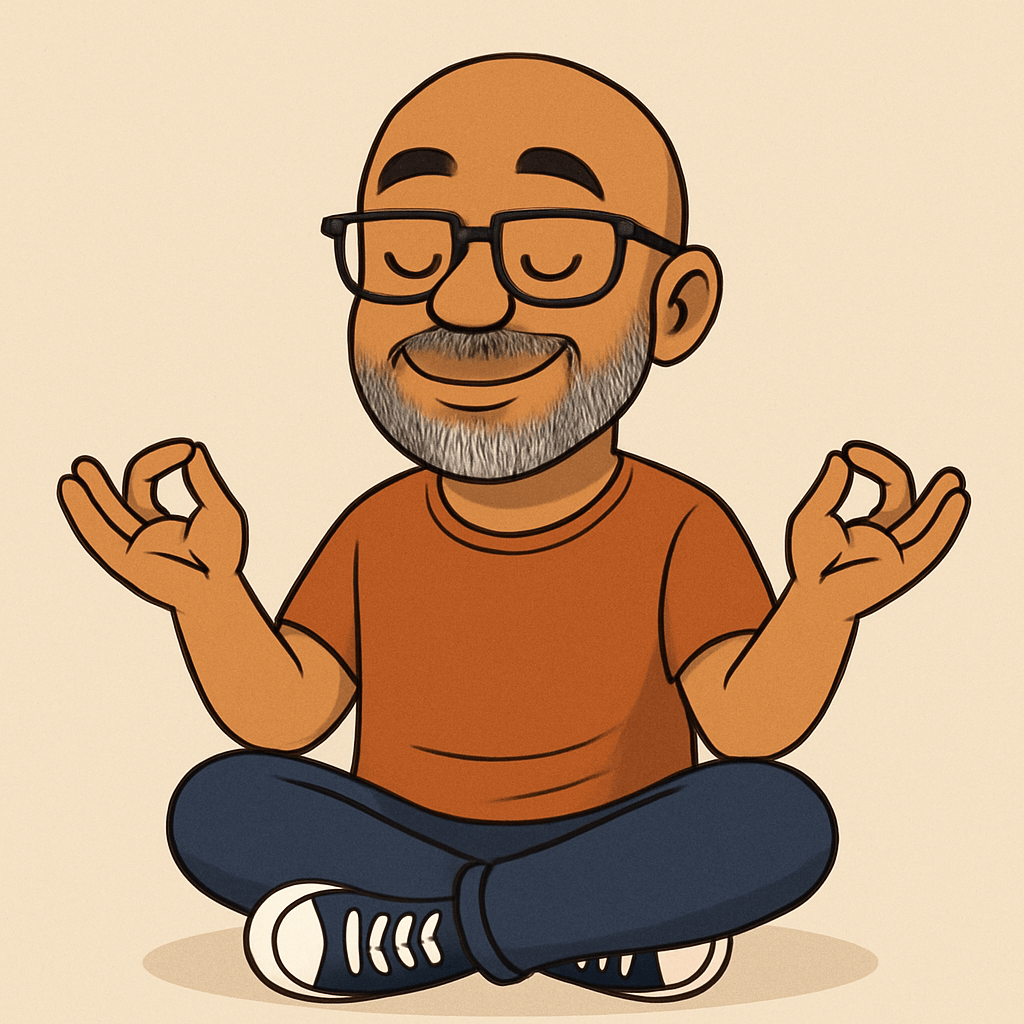
Omnm Omm Omm
I used to push through it. Pretend. Deny. Perform. But lately, I’ve started asking myself a different question:
“Who do I need to be visible to? Them… or me?” If I don’t show up for myself, I’m ghosting the one person I can’t escape—Me.
You don’t know what I know. You ain’t saw what I saw.
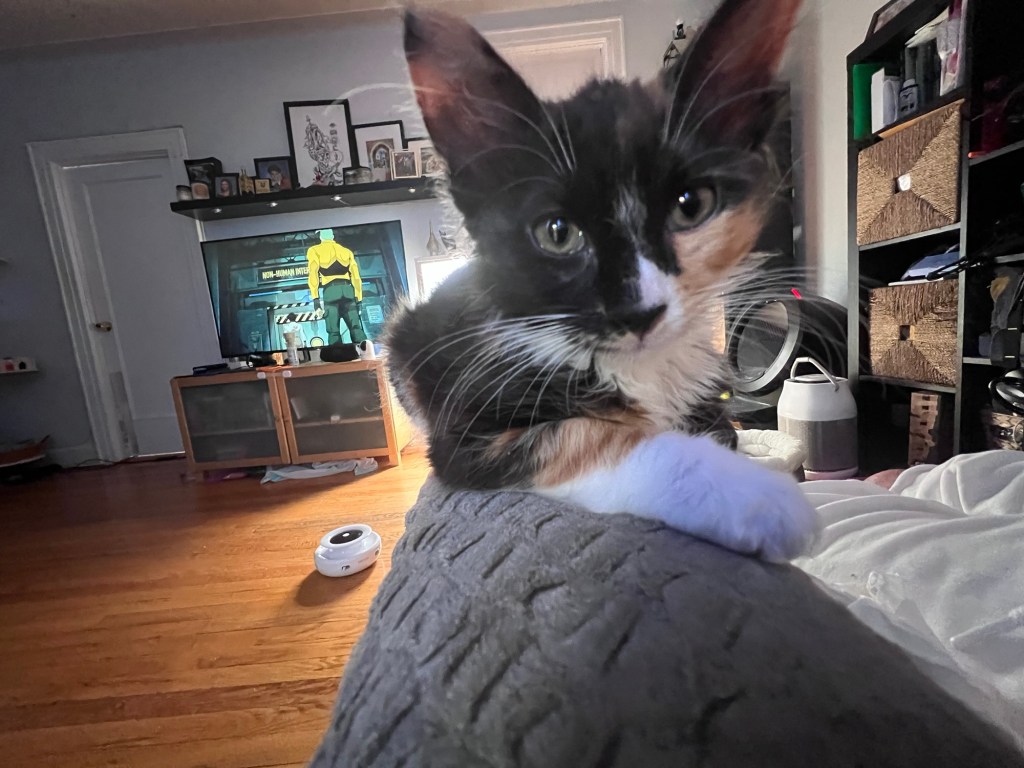
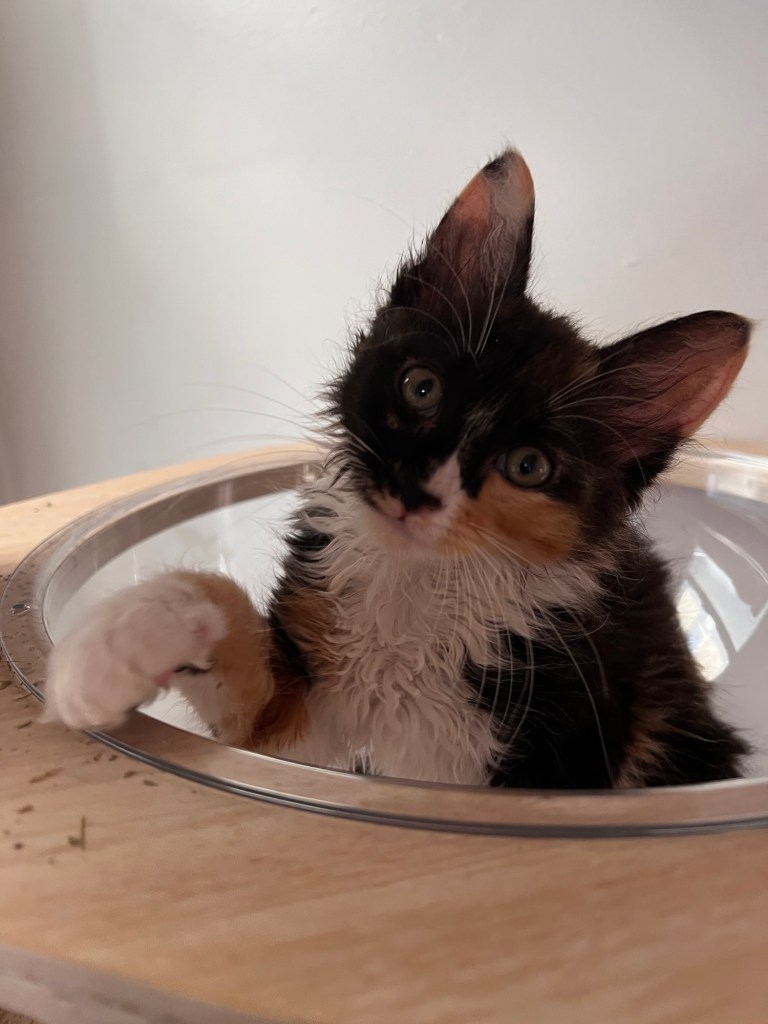
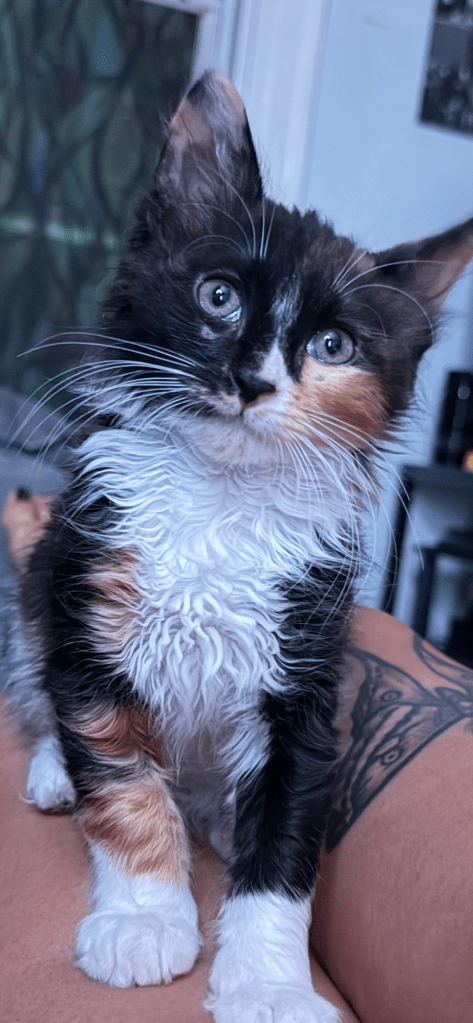
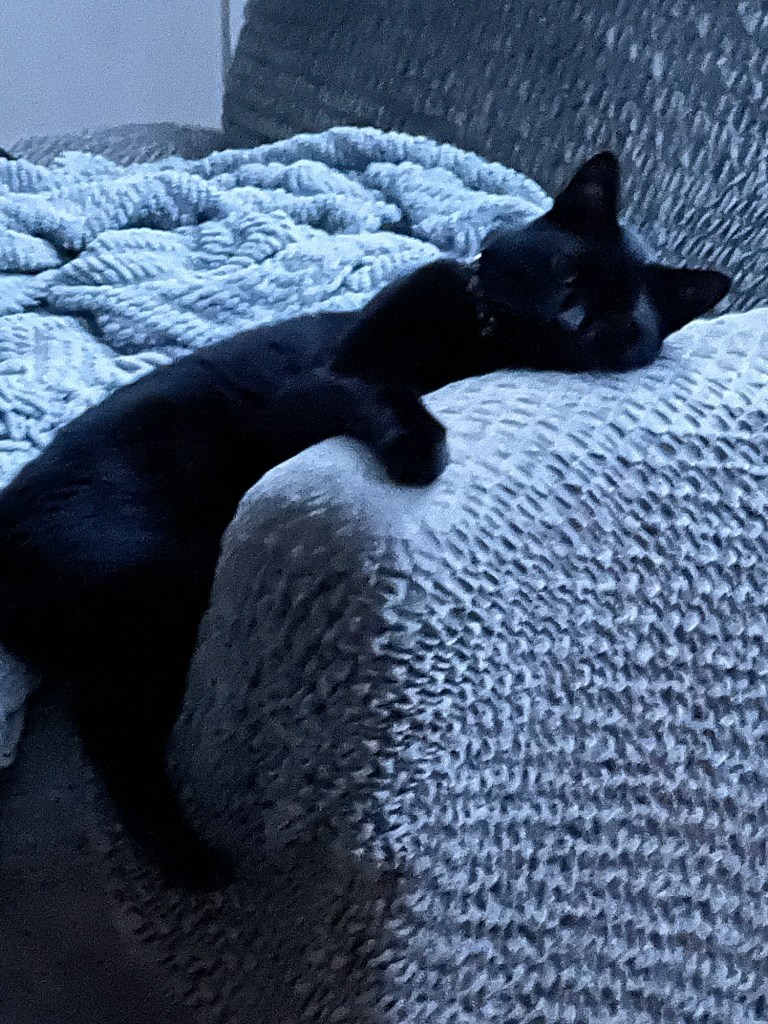
And speaking of visibility… meet my new therapist, pet soulmate, and chaos coordinator: Amira the cat. We adopted her a few weeks ago. she is only three months old, and I’m convinced she’s here to teach me inner peace by driving everyone else insane. She is a “pulga” jumping, and hopping everywhere.
This cat has ADHD, and zero respect for boundaries, basically, she fits right in with the fam. But watching her is like watching a masterclass in unapologetic presence. When she’s tired, she sleeps. When she wants love, shes looking for takers. When she sees any of the cats in the hallway at 3am, she chases at them like they owe her money. Iconic.
Y’all ain’t ready for this chaos.
In a weird way, she reminds me what I’ve been trying to learn this whole MS journey:
You don’t owe anyone an explanation for your body’s rhythms. Your healing isn’t a performance. Your stillness isn’t laziness, it’s a spiritual boundary.
Summer July this year is no joke! The air is thick like regret, the sidewalk shimmers like a mirage, and my MS is flipping channels with no remote. But I’m still here. Melting a little. Laughing a lot. Learning to honor the invisibles, like faith, fatigue, and the fierce joy of showing up anyway.
“It happened so fast, I didn’t even feel the blast”
Since my new job recently, I don’t have access to a computer where I would normally past my time by writing in my blog. So here I am doing this on my iPhone 13. So here we go!
In just a few weeks, I quit my job, took a breath (finally), and walked straight into a brand-new chapter. I swapped sly comments from my manager for balance, cold leadership for warm-hearted teammates, and plot twist I became a cat grand dad.
But let’s rewind for a second.
Leaving my job at Equitable wasn’t a snap decision. It’s been a long journey of resume sending, ghosted interviews. I spent everyday for the past three years refreshing my emails. In hopes there was a new opportunity waiting to happen for me. I gave that place 15 years of my life. 15! That’s longer than some of these financial planners have even had a driver’s license.
I didn’t expect a grand exit, but what I got truly moved me: genuine love and support, not from management, but from my coworkers. The planners. My team. The people I worked with, not for.
This is one of many cards I received.
The folks I supported showed up with kindness, encouragement, and reminders that I mattered. They made me feel seen and valued in ways I hadn’t felt in years. It was healing. It felt like this to very moment I was leaving those doors for the last time. I had a parade of people walking me to the elevator bank. I even had one guy chase me down the block to hand deliver the card you see above.
So what about the leadership or management? You know the ones you had meeting lunches with, the ones who wanted white glove treatment?…Crickets. No farewell lunch. No handshake. Not even a thank you. Just the same quiet indifference they’d shown whenever I asked for small things—like empathy—and compassion.
When you live with a chronic illness like MS, that silence hits different. I never asked for special treatment. Just humanity. I think collectively we are all lacking this fundamental component. We could talk about this in depth at a later date. This is not to offend the reader, this is towards the ones you know well.
So yeah, I left.
And for one whole week, I did something wild—I rested. I breathed. I let myself be still. I’m lying!! I played video games for 12 hours everyday. I’m sorry but I am just hooked to this one Xbox game. Then I started a new role. One that came with more responsibility and, finally flexibility!
At Telstra, I’ve found a team that’s not just sharp, but kind. People who greet me with respect. Who understand that contribution doesn’t always look the same for everyone.
And still… I was scared.
That week before my start date? I was on edge. Anxiety in full swing. I barely slept. My wife was concerned. Meditating couldn’t help me. My mind was stuck on loop:
What if I can’t do this?
What if I made the wrong call?
What if they see my wheelchair before they see me?
Spoiler alert: Fear lies.
This team has welcomed me in every way that matters. I show up. I contribute. And slowly but surely, I’m starting to believe again, not just in the work, but in myself. You got this kid!
Oh—and my favorite at home coworker? She doesn’t even get a W-2.
Meet Amira Lynn, our new cat. She’s already the queen of the house. We suspect she has a little feline ADHD (zoomies at every time O’Clock sharp), but she brings the kind of joy that fills a room, and maybe leaves a few claw marks.
She’s chaos, sure. But the best kind. The kind that makes you laugh. The kind that reminds you that love doesn’t always sit still.
So yeah, it’s been a ride. New beginnings are rarely smooth. But sometimes, when you walk away from what no longer serves you, you find a door you didn’t even know was there.
To anyone standing at the edge of change: trust yourself. Even if your voice shakes. Especially if it shakes.
Signing off until next time with love (and cat hair),
Let me start with a little disclaimer before we dive into this fun post: I’ve never had an actual roommate in my life. I do, however, jokingly refer to my two kids as our “roommates.” Because let’s be honest—they eat all your food, never wash dishes, and leave a mess everywhere. Yep, those are my kids. And I bet you’ve got a pair like them living in your house, too. They’ve gotten better, but there’s still room for improvement. These days, the chaos at home isn’t quite as disorganized as it once was—thanks to them getting older—but they still manage to make the house look like a ghetto version of HomeGoods from time to time. Organized, but wildly out of place. You know what I’m saying?
My wife and I kind of chose these two to share space with, and that’s one of the joys of parenting. Some roommates you pick. Others? They just show up—with a suitcase, a spare key, and no intention of ever leaving. That’s how Multiple Sclerosis moved into my life. No knock on the door. No warning. Just—boom—guess who stepped in the room? And no, it’s not paying rent either. What’s the Wi-Fi password? It’s that kind of vibe I’m talking about.
Roomate #1 & #2
Here’s the twist: I believe G.U.S. (God, Universe, Spirit) doesn’t make house calls without a reason. So, I began to see this unwanted tenant not just as a chronic condition, but as a spiritual coach—annoying, inconvenient, yet strangely enlightening. MS has slowed me down. It’s humbled me. It’s forced me to ask deeper questions. And in that stillness, I hear something sacred whispering back. Sometimes it says, “Get up—move in whatever way you can.”
But my favorite whisper?
“You are greater than this.”
This blog isn’t about suffering. It’s about how suffering cracked me open—and allowed me to see the divine in everything. In the broken places, the light keeps finding its way in. My path doesn’t follow a straight direction—it’s already been completed, preordained by my soul’s purpose. There’s no point trying to fight what’s destined. My role is to let go and simply observe how this gift of life will bloom. Play along, avoid the plastic, and be authentic every day. Because honestly? My life is okay. Yes, I am sick, but this doesn’t stop me from existing.
Living with MS has transformed daily routines into sacred rituals. Getting out of bed isn’t just about brushing my teeth and chasing the day. It’s an act of gratitude. Some mornings, just sitting up feels like a ceremony. My legs may not cooperate, my balance might be off, but the awareness I’ve gained? That’s divine.
Before MS, I chased life like most people do. I chased work. I cornered the gym. I held my errands hostage until they surrendered. I ran to my family. I ran to take my kids to their events. Looking back, I realize I was living almost robotically—caught in a marathon toward things that “defined” me. Now? My relationship with life has changed. I listen to it. I’ve been forced to stay still. I’ve come to believe my body is a map, and MS is the red ink showing me exactly where to slow down and tune in.
G.U.S. and I talk often—not always with words. Sometimes it’s through anxiety. Sometimes through breath. Frustration. Or a 4 a.m. laugh when I drop something for the fourth time and just say, “Really? This again?” And even in that moment—there’s a lesson. Or at least a cosmic smirk. Spirituality, for me, isn’t incense, Zen music, or transcendence. It’s raw. It’s real. It’s present—in my wheelchair. It’s sleepless nights, discomfort, falling to the floor and getting back up. It’s waking up and sensing what kind of day I’m going to have. It’s in the way my wife looks at me when I’m struggling—and doesn’t flinch. It’s in the surrender to what is—without giving up who I am.
MS didn’t just change my body. It rearranged my soul’s furniture. And here’s the part no one tells you: sometimes, the hardest roommates are the ones who teach you how to live. Speaking of roommates, I’ve learned from my kids that change comes slow—and it slips through your fingers sometimes. So yeah… MS still lives here. We bump into each other in the hallway, argue over space, and it definitely eats more than its share of my energy snacks. But we’ve reached an understanding. I stopped trying to evict it. It stopped trying to ruin every room in my body.
Now, we coexist. Some mornings it’s quiet and respectful. Other days, it blasts music at 6 a.m. and clogs up the bathroom tub. But even then, I remind myself—this isn’t just about disease. It’s about discovery. MS didn’t break me. It broke me open. And through those cracks, G.U.S. moved in—with all the love, lessons, and mystery I didn’t know I needed. So now it’s a crowded apartment: me, MS, and G.U.S.—doing this weird, wonderful dance called life. Some days I lead. Some days I lean. And some days, I just laugh. Because honestly…
Who knew enlightenment came with mobility aids and a roommate who doesn’t do chores?
Last week gave me a bitter sample of what life could look like if I had to do this MS thing with no safety net. No wife reminding me to take my medication. No kids helping with small things that feel like mountains. No one checking in just to say, “You good?” It was quiet. Too quiet. And that silence? It wasn’t peace—it was a preview.
This month, my wife went on a well-deserved solo vacation to Africa (Morocco) to be with our daughter, who’s studying abroad. At first, when it was just talk, I was genuinely happy for her. As the days drew closer, I stayed excited for her. I knew this trip could be a much-needed reset. Caring for someone with a chronic illness like Multiple Sclerosis isn’t easy, and I’ve always known that. But I had one lingering question: “Could my wife do this trip without me?”
I’m leaving on a jet plane, I don’t know when I’ll be back again.
You see, back when I was healthier, I was the team leader on all vacations. I carried all the passports, held the mobile tickets in my “murse” (that’s a man’s version of a purse), and played the role of chauffeur, butler, and part-time barista as well. I would make sure my wife had her happy juice by 10 a.m. because, hey—it’s 5 o’clock somewhere in the world.
While I was focused on how she’d manage without me, I didn’t give a second thought to how I’d manage without her for a week. Who was going to cook? Take my plate to the kitchen? Get me water or pick up the remote I dropped? Work was out of the question—there was no one to get me out the door or receive me when I came back. My manager wasn’t thrilled to hear I’d be off for nine days. I offered to work from home. No response. Silence. Corporate America doing what it does best…..ghosting.
There was not a moment I could’ve given my wife a proper sendoff before she left. The living room was filled with two suitcases and an oversized carry-on that could’ve fit a week’s worth of Trader Joe’s groceries. I had therapy that afternoon, so I didn’t walk her out. When my session ended, I came back to a quiet, empty apartment, and loneliness hit like a sucker punch. “Well… here we go. You got this, Jon.” That night, I wasn’t too bothered. I had the bed all to myself, and I made it into a fortress. Best pillows for snuggling, one for my head, two for my calves. I floated through the night like a king. Great sleep. Great dreams.
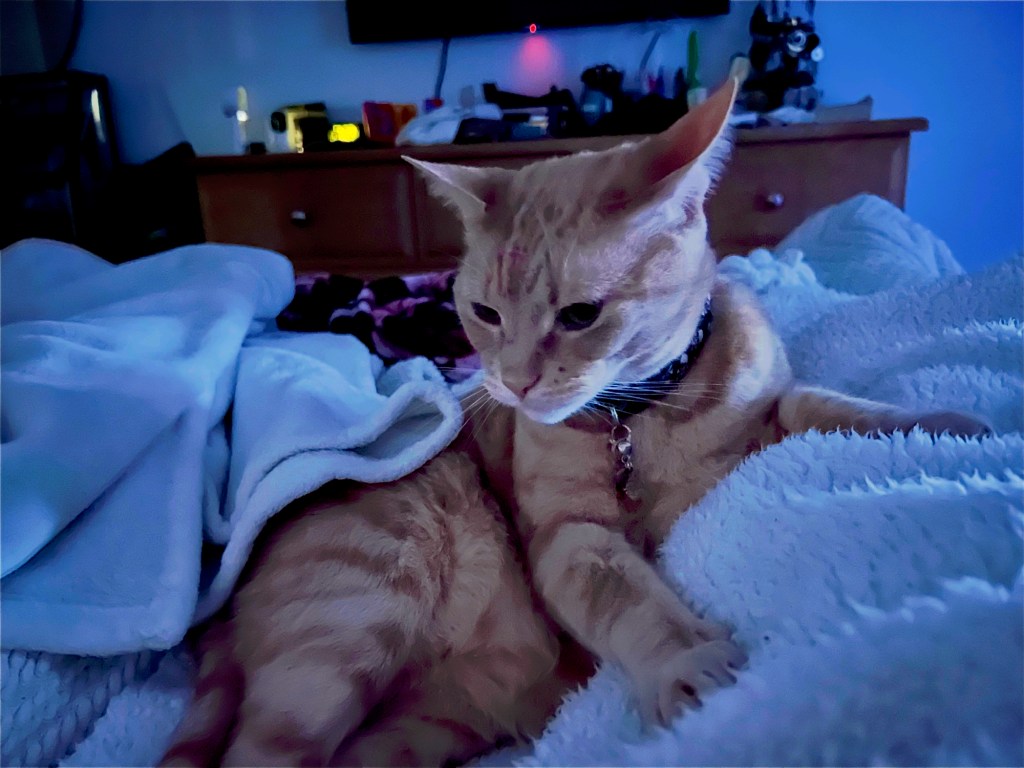
Yes I am a cat dad.
But the next morning was different.
My son was home, getting ready for school, so I wasn’t technically alone yet. But once he left, the silence moved in. No sound—except the occasional door creaking downstairs, a car zooming by with bass on blast, or my cats doing what cats do. One of them purred so loud it sounded like I was living inside a Dolby Surround Sound commercial. The other? Snored so hard, I thought the lights might flicker off. And my heartbeat? It was giving shamanic healing drum circle energy. So I meditated from time to time alone at home.
Am I alone?
But the silence didn’t stay silent for long. It morphed into that other kind of noise; the one in your head. The voice that kicks your mental door down like, “BOOM, guess who’s stepped into the room?!” And just like that, the intrusive thoughts took over:
“What if I fall? Who’s here to call 911?”
“Would anyone find me in time?”
“Could I bleed out alone in my apartment while emergency services try to get into the apartment?”
I felt trapped. My building has stairs, and my wheelchair can’t make it down the last part. If I had an elevator, I could at least roll to the park, grab some lunch, feel the sun on my face. But nah I’m here, grounded by concrete and circumstance. That inner voice? It didn’t let up.
“You could be doing better for yourself.”
And to be fair, it wasn’t wrong.
My MS workouts leave me depleted. I barely do them anymore. They feel pointless because the results don’t show. But I know deep down they’re not about short-term wins. They’re about preserving what little strength I’ve got left. They help with mood, too. Still, I’ve gained a lot of weight since 2022. I swore in 2007 I’d never be “Fat Jon” again. But here I am. Can’t hide it. Can’t suck it in. But… f**k it.
So while my wife was away, I tried a few new things. Chair yoga. An online aerobics class. Both had me so wiped, I couldn’t walk after. I was out of breath, out of shape, and definitely out of alignment. I even skipped the last ten minutes of the class. No shame. After moving my body, I nourished it. Made breakfast. Then I listened to a history book on Spotify, America for Americans by Erika Lee. This book here was upsetting for me. Whew. Let’s just say it’ll make you lose your appetite and your faith in flags. “Make America Great Again?” When exactly was that? Asking for every immigrant family ever. Spoiler alert: This country has a mean streak. But I digress…
Back to being alone.
With no distractions, I got a lot done. Wrote a few blogs. Reflected. Got honest. When you’re left with just yourself, things get real clear, real quick. Why am I still fighting for mobility, for a life that flipped on me? Why am I still pushing? Because somewhere deep inside, under the layers of grief and grit, I still believe in what’s possible. I miss paintball with the fam. Boxing with my BFF. Basketball with my son. I miss beach walks with my wife while on vacation.
Truth is, this disease humbled me. It cooled me down. Mentally. Before MS, I was wild. Loud. Selfish. Rude. Now? I listen more. I pause. I see people better. I feel things deeper. And in that silent stillness, between my cats doing purr sound checks and my own thoughts pacing the room, something shifted. Loneliness started speaking a different language. Not fear. Not grief. But truth. And strength. And reflection. I started seeing my alone time not just as isolation, but as revelation. A kind of spiritual download, like the new age spirituality folks say. Because when you’re forced to be with only yourself, the mirror isn’t glass, it’s internal.
With this new realization I knew I wasn’t going to stay still.
I realized this:I don’t want to do this alone. But for a moment, I think I could.
I cooked when I could.
Rested when I needed.
Cried without shame.
Laughed mid-struggle.
Stretched.
Typed.
Journaled.
I listened.
I survived.
And sometimes… surviving is the flex.
I don’t ever want to do life, or MS….without the love I’m blessed with. My wife. My kids. My furry roommates. My tribe. But now I see that even when I’m alone, I’m not powerless. This disease has taken a lot from me, but it handed me back this truth:
Even by myself, I’m still here.
Still listening.
Still fighting.
Still me.
And if I had it my way? I’d still prefer someone in the next room yelling, “Babe, did you take your meds?!” Because connection? That’s part of the medicine. Support is spiritual. Love is adaptive equipment. And my people? They’re my ramp back to sanity, purpose, and joy. I’ll never take them for granted again, not the voices that check in, the hands that help, or the presence that makes the silence less loud. I survived, but it wasn’t cute. I was out here dropping remotes, burning toast, and giving myself motivational speeches like I was Gary V . I proved I can do it alone….but why would I want to. While I held it together, while I pulled strength from places, I didn’t even know were still alive in me. I say all this to say this one last point, and let me be crystal clear: I am capable of being alone, but I wasn’t made to thrive alone. This Journey with Multiple Sclerosis isn’t just about resilience; like I said earlier, it’s about relationships, Love, Connection. The folks who help me laugh when I want to cry (which is always), who bring warmth to the coldest days, who remind me I’m more than this diagnosis. Doing it alone taught me I’m strong. But being seen, being held, makes me whole.
Because surviving is one thing but thriving? That takes people.